Reading time: 5 minutes | Published: July 14, 2026
On July 10, 2026, eight of the most influential organizations in the music industry announced something that will affect every artist distributing music online, whether they use AI tools or not.
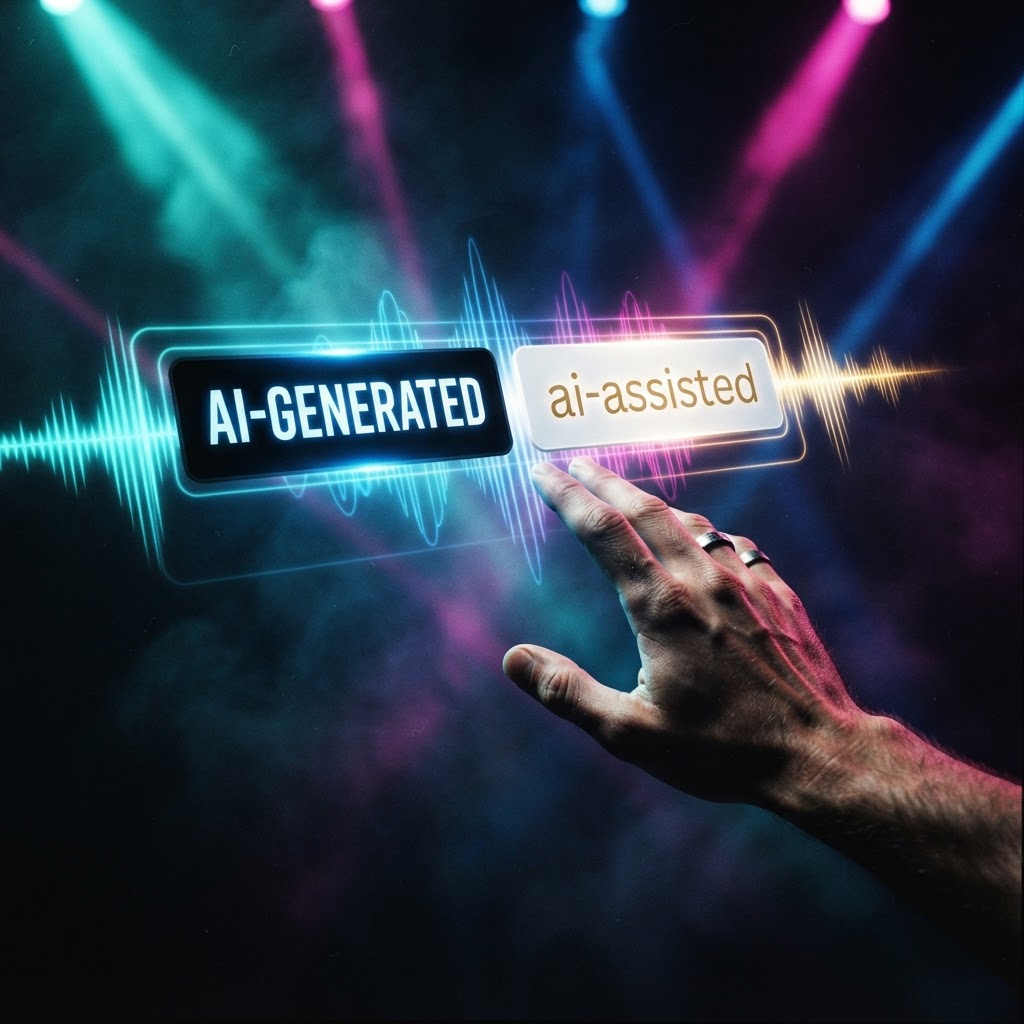
IFPI, RIAA, A2IM, WIN, IMPALA, the Recording Academy, SAG-AFTRA, and the Human Artistry Campaign jointly announced a voluntary track-level labeling system for AI-generated music. The system creates two distinct labels: AI-Generated and AI-Assisted. Starting now, those labels are designed to travel with a recording from creator to distributor to streaming platform to fan.
This is not a small procedural update. It is the beginning of a new transparency standard for the entire music ecosystem. Independent artists need to understand what it means for them before their distributor starts asking questions they are not prepared to answer.
What the two labels actually mean
The distinction matters, and it is more nuanced than it first appears.
An AI-Generated label applies to a track where generative AI produced the entirety or the primary portion of the creative content. That means a track built entirely from a text prompt, a recording where the lead vocal was generated by AI, or a song where the main instrumental performances came from a machine rather than a musician.
An AI-Assisted label applies to a track that was created substantially by humans, where generative AI was used for some expressive elements. The lead vocal and primary instruments are human. AI may have contributed to production, arrangement, sound design, or other supporting elements.
What the system does not cover, at least for now, is AI used in lyrics, composition, music videos, or cover art. Those remain outside the scope of this announcement.
Why this is happening now
The numbers make clear why the industry moved.
In April 2026, Deezer reported it was receiving close to 75,000 AI-generated tracks per day, representing roughly 44 percent of all new music uploaded to the platform. An Apple Music executive told Billboard that more than one third of new monthly uploads to the platform are, in their words, 100 percent AI. A Deezer survey found that 97 percent of listeners could not distinguish AI-generated songs from human-made ones. The same survey found that 80 percent of listeners wanted fully AI tracks clearly labeled.
The industry is responding to a real problem. AI music is flooding platforms at a scale that automated detection systems are struggling to keep pace with. Without labeling, fans have no way to know what they are listening to. And without transparency, the trust that connects artists to audiences erodes.
“Fans want to know whether and how generative AI has been used in the music to which they listen,” said IFPI CEO Vikki Oakley and RIAA Chairman Mitch Glazier in a joint statement. “Given how important human artistry and authenticity is to music lovers all over the world, these labels will provide an immediately understandable and easily scalable approach to transparency.”
What this looks like in practice
The labels are designed to function much like the Explicit Content marker that already exists on streaming platforms: two visual icons at the track level, one for AI-Generated content, one for AI-Assisted.
Critically, the system is currently voluntary. Artists, labels, and distributors self-declare AI use. No universal automated detection system exists across all platforms, which is part of why a standardized labeling infrastructure matters.
Several platforms have already moved independently. Spotify removed more than 75 million spammy tracks over the 12 months prior to September 2025, according to its own newsroom, and began testing AI tags in song credits in April 2026. Deezer has been tagging AI music at the platform level since 2025 and strips 85 percent of AI music streams as fraudulent before paying royalties. Apple Music launched its AI Transparency Tags system in March 2026, relying on labels and distributors to declare AI content. TIDAL announced in late June that it would tag fully AI-generated tracks and, beginning July 15, 2026, those tracks will no longer be eligible for royalty payments under its policy.
The Digital Media Association, which represents Spotify, Apple Music, and others, said it was watching the announcement and wants reliable AI data to travel the entire path from creator to fan. It has not yet confirmed whether its members will adopt the two proposed tags.
What independent artists should do right now
If you use AI tools in your music production, start documenting how. That documentation will matter when your distributor asks. The question is not whether you have used AI. The question is how you have used it, and whether that use is substantial enough to trigger a label.
If your lead vocals are human, your primary instruments are human, and you used an AI plugin to help with reverb or a stem separator to clean up a sample, that is a different situation than a track generated entirely from a text prompt. The distinction between AI-Assisted and AI-Generated is the one that will shape how your music is presented to listeners.
A few steps worth taking before this becomes standard practice across distributors.
Know your distributor’s current policy. Several distributors have already begun requiring AI disclosure at the point of upload. DistroKid, TuneCore, and CD Baby have all updated their terms of service in the past year to address AI-generated content. Read yours carefully.
Be honest in your disclosures. The labeling system is voluntary right now, but the infrastructure being built around it is not going away. Artists who establish a track record of accurate disclosure are in a much stronger position as the standard evolves than those caught misrepresenting their work later.
Understand that transparency is an asset. Human artistry is increasingly valued precisely because AI has made it harder to take for granted. The new labeling framework is designed to give artists a way to communicate authenticity clearly. That opportunity is worth understanding, even if the full rollout is still in progress.
What this means for the independent music community
The announcement carries particular weight for independent artists and labels. A2IM CEO Ian Harrison was direct about it: “The independent community knows the magic of music lives in an authentic connection between artists and fans. Technology will keep offering new ways to make and enjoy music, but that bond still runs on trust.”
The harder question is enforcement. Voluntary labeling depends on honest disclosure. Deezer has noted that up to 85 percent of streams on fully AI-generated music were fraudulent in 2025, suggesting that the category most likely to be mislabeled is the one already associated with bad-faith behavior. The industry is building infrastructure, but infrastructure without accountability only goes so far.
This is a first step, not a finished system. The labels exist. The definitions are set. What comes next — platform adoption, distributor requirements, and eventual enforcement — is still developing. Independent artists who understand the framework now will be better positioned as it does.
SyncNation Takeaway
The AI labeling system is real, backed by the full weight of the music industry’s major organizations, and coming to the platforms where your music lives. Whether you use AI in your creative process or not, understanding these labels is part of operating professionally in 2026. Know the distinction. Know your distributor’s policy. And treat transparency not as a burden but as a standard worth building your reputation on.
Sources Consulted
- IFPI official announcement, July 10, 2026 — ifpi.org
- Music Business Worldwide, “Record Industry Proposes AI Labeling System,” July 10, 2026
- France24, “Music Industry Launches AI-Generated Content Labels,” July 10, 2026
- TechCrunch, “Deezer says 44% of songs uploaded daily are AI-generated,” April 20, 2026
- Ars Technica, “Deezer says 44% of new music uploads are AI-generated,” April 20, 2026
- Music.ly, “More than a third of Apple Music uploads are now AI music,” April 23, 2026
- TechRadar, “Over a third of Apple Music uploads are 100% AI,” April 2026
- Spotify Newsroom, “Spotify Strengthens AI Protections,” September 25, 2025 — newsroom.spotify.com
- Variety, “Tidal to Label AI-Generated Music, Ban Royalties from AI Songs,” June 2026
- TIDAL Support, AI Policy effective July 15, 2026 — support.tidal.com
Have a story idea or tip for the SyncNation editorial team? Send pitches to press@syncnationmag.com.